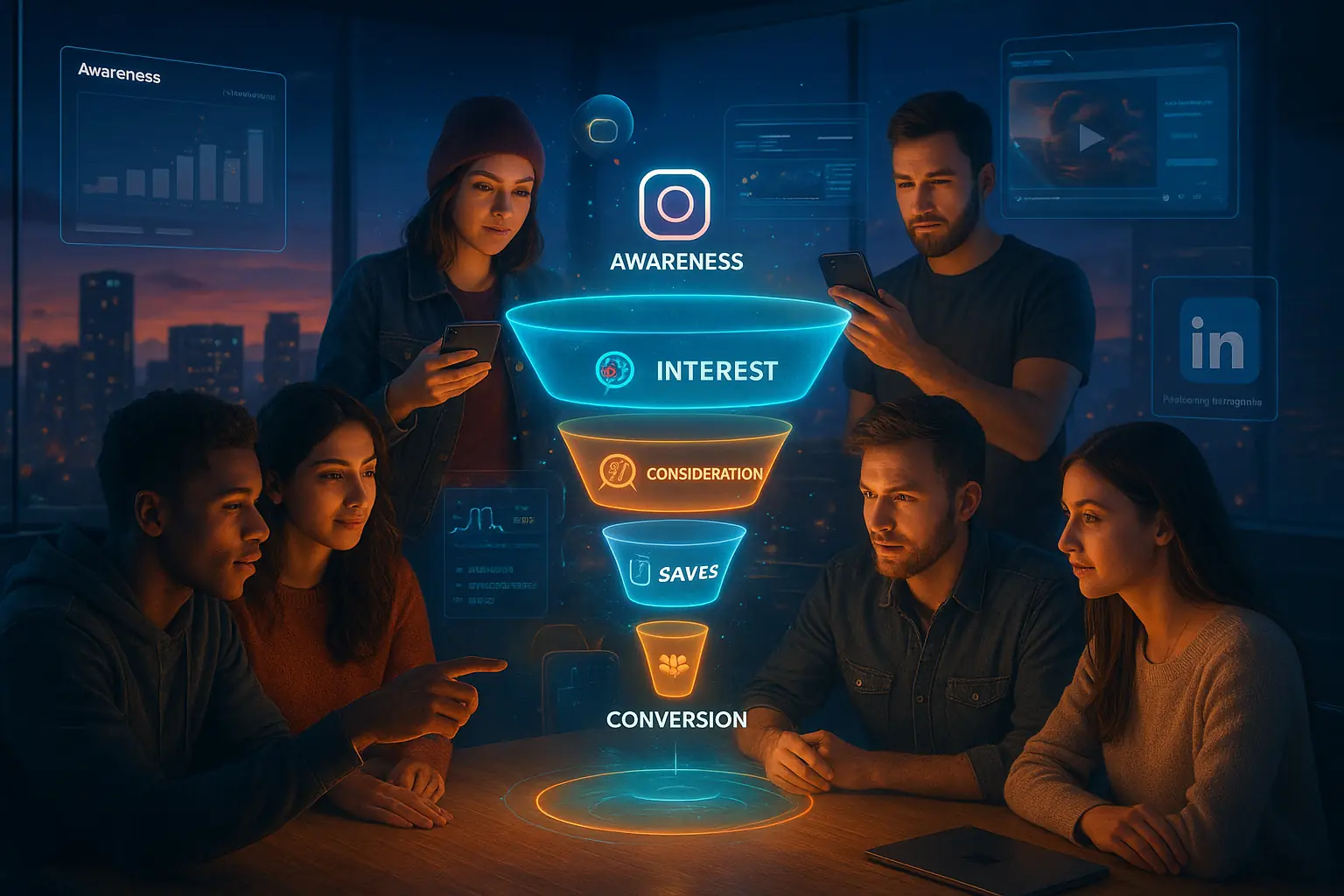
Most brands don't fail at digital marketing because they pick the wrong platform. They fail because they treat each channel as a separate experiment rather than a coordinated system. A brand might run polished video ads while its social presence sits dormant. Another invests heavily in influencer promotions without any paid amplification to extend the reach. The result in both cases is the same: diminishing returns and a growing sense that digital marketing is unpredictable.
It isn't unpredictable. It's just misunderstood as a collection of tactics rather than an architecture. Social media marketing builds the relationship layer. Digital advertising campaigns extend reach and drive action with precision. Influencer promotions introduce trust through familiar voices. Video content creates the emotional and informational depth that text alone cannot. When these elements share a common strategy, they amplify each other. Platforms like TikTok have become particularly powerful in this ecosystem - and understanding how a tiktok ad account functions within a broader paid campaign can dramatically change what's achievable at the top of the funnel.
This article breaks down each component, explains how they interact, and gives you a practical framework for building a digital engagement strategy that actually compounds over time. Whether you're managing marketing for a growing brand or refining an existing approach, the goal is the same: turn fragmented activity into a coherent system that earns attention and converts it into lasting results.
Understanding the Digital Engagement Ecosystem
Before any tactic makes sense, the underlying logic of digital engagement needs to be clear. The components most marketers work with - social media, paid advertising, influencer content, and video - are not parallel options to choose between. They occupy different psychological positions in a buyer's journey, and they work best when they're deliberately connected.
Think about how a potential customer actually encounters a brand. They might first see a short video clip in a social feed. Later, a mid-tier creator they follow mentions the product in an authentic way. Then a retargeted ad reminds them of what they viewed. Eventually, they visit a product page and convert. No single touchpoint made that sale. The system did.
This is the engagement ecosystem: a set of interlocking channels where each element plays a specific role. Social media marketing handles ongoing presence and community. Digital advertising campaigns provide scalable, targeted reach. Influencer promotions deliver credibility and social proof. Audience targeting strategies determine who sees what and when. Video content creation carries the message in the format most likely to hold attention. When these are aligned around a shared narrative and objective, they create a compounding effect that no single-channel investment can replicate.
A useful way to organize this is through a staged model:
- Awareness: Social media presence, influencer content, video discovery through paid and organic reach
- Interest: Targeted video ads, educational content, community engagement that deepens familiarity
- Consideration: Retargeting campaigns, influencer reviews, testimonials and product demonstrations
- Conversion: Direct response ads, optimized landing experiences, clear calls to action
- Loyalty: Ongoing social engagement, exclusive content, community-building that reduces churn
Understanding where each channel fits within this progression is the prerequisite for everything that follows. Without it, budget allocation becomes guesswork and performance data becomes noise.
Building a High-Impact Social Media Marketing Strategy
Social media marketing is the connective tissue of your digital strategy. It's where your brand voice lives between campaigns, where relationships are maintained, and where organic credibility is either built or lost. But effective social media work in a competitive environment requires more than a consistent posting schedule. It demands platform literacy, a clear editorial point of view, and the discipline to measure what actually matters.
Choosing the Right Platforms for Your Audience
Platform selection is one of the most consequential early decisions a brand makes, and it's frequently made on intuition rather than evidence. The principle is straightforward: be where your specific audience is most active and most receptive, not everywhere simultaneously. Spreading effort across six platforms with mediocre execution on all of them produces weaker results than deep, quality engagement on two.
| Platform | Primary Audience | Best Content Formats | Strongest Use Case |
|---|---|---|---|
| 18-34, lifestyle-oriented | Reels, Stories, carousels | Brand aesthetics, product discovery | |
| TikTok | 16-34, entertainment-focused | Short-form video, trend formats | Viral reach, younger audience engagement |
| 25-54, professionals | Articles, thought leadership posts | B2B marketing, authority building | |
| YouTube | Broad, 18-49 dominant | Long-form video, tutorials, reviews | Education, evergreen search-driven content |
| 30-55+, community-driven | Groups, events, mixed media | Community management, retargeting | |
| X (Twitter) | 25-45, news and culture | Short text, threads, video clips | Real-time conversation, brand voice |
The practical approach is to anchor your strategy on one or two primary platforms that align with your audience demographics and content strengths. Expand to additional channels only when you can sustain quality execution there, not simply because the platform is popular.
Content Planning and Editorial Cadence
Consistency signals credibility - both to platform algorithms and to the people who follow you. A reliable content calendar removes the decision fatigue of daily posting and ensures that promotional content doesn't crowd out the value-driven material that actually builds audience trust. One framework that holds up well across categories is a rough split of content by intent:
- Value-driven content (roughly 70%): Practical tips, original perspectives, behind-the-scenes glimpses, entertainment, and industry insights that enrich the audience's feed
- Community content (roughly 20%): Replies, reposts, user-generated material, and conversation starters that demonstrate genuine participation in your community
- Promotional content (roughly 10%): Product launches, offers, announcements, and direct calls to action
The most common editorial mistake brands make on social media is inverting this ratio. When promotional content dominates, follower growth slows, engagement drops, and organic reach contracts. Audiences follow accounts that consistently deliver something worth stopping for.
Metrics That Actually Measure Engagement
Follower count is the vanity metric most brands still optimize for, despite years of evidence that it correlates poorly with business results. A more honest measurement approach starts with your objective and works backward to the metrics that actually reflect progress toward it.
| Objective | Primary Metrics | What to Watch For |
|---|---|---|
| Awareness | Reach, impressions, share of voice | Consistent month-over-month growth |
| Engagement | Likes, comments, shares, saves | Saves often signal deeper interest than likes |
| Traffic | Link clicks, referral sessions | Quality of traffic, not just raw volume |
| Conversion | Lead generation, purchases, sign-ups | Attribution and assisted conversions |
| Loyalty | Repeat engagement, follower retention | Comment sentiment, direct message volume |
One metric worth paying close attention to on most platforms is saves. When someone saves a post, they're signaling that the content has lasting value to them - a far stronger indicator of genuine interest than a passive like. Platforms tend to reward this behavior with expanded organic reach as well.
Designing and Executing Effective Digital Advertising Campaigns
Organic content builds trust, but it reaches a limited and self-selected audience. Paid digital advertising campaigns allow you to introduce your brand to people who have never encountered it, re-engage those who have, and test messaging at a speed and scale that organic efforts cannot match. The difference between campaigns that work and those that drain budget is almost always structural rather than creative.
Campaign Architecture: Structure Before Spend
Launching a paid campaign without a deliberate structure is one of the most expensive habits in digital marketing. Disorganized campaigns make optimization nearly impossible because you can't isolate what's working. A sound architecture follows a clear sequence before a single dollar is committed:
- Define the objective: Platforms optimize delivery based on the campaign goal you set. Choosing awareness when you want conversions - or vice versa - misdirects the entire campaign from the start.
- Segment your audiences: Cold audiences (no prior brand contact), warm audiences (past engagers or site visitors), and retargeting audiences require different creative approaches and bidding logic.
- Set budget allocation: Distribute spend across funnel stages in proportion to your current business priority, not arbitrarily.
- Build creative assets: Match format and message to both the platform's content culture and the audience segment's likely mindset at that stage.
- Establish testing protocols: Decide in advance which variable you're testing and what a meaningful result looks like. Changing multiple elements simultaneously makes learning impossible.
- Monitor and optimize: Review performance on a defined schedule. Reactive changes within the first 48 to 72 hours of a campaign launch typically do more harm than good as the platform is still in its learning phase.
Audience Targeting Strategies That Reduce Wasted Spend
Precision targeting is the core advantage of digital advertising over every form of broadcast media that preceded it. The ability to define who sees your message - and under what conditions - fundamentally changes the economics of customer acquisition. Modern platforms offer a layered set of audience targeting strategies that, when applied intelligently, improve return on ad spend significantly.
- Demographic targeting: Age, gender, location, language, and household income level form the baseline of any audience definition
- Interest and behavioral targeting: Based on platform activity, content consumption patterns, and inferred purchase intent
- Lookalike audiences: Algorithmically generated audiences that mirror the profile of your best existing customers, used to find new prospects at scale
- Custom audiences: Built from first-party data such as CRM lists, website visitors, or past purchasers - typically your highest-intent targeting option
- Contextual targeting: Aligning ad placement with relevant content environments rather than relying exclusively on user-level data
- Retargeting: Re-engaging users who have already interacted with your brand but have not yet converted
A common structural error is over-narrowing the audience too early in a campaign's life. Beginning with a broader audience and tightening based on actual performance signals - rather than assumptions - consistently produces better results. Let the data identify your best audience rather than imposing your hypothesis onto it before you have evidence.
Budget Allocation Across Platforms and Funnel Stages
No universal budget formula applies to every brand or category, but the following framework provides a defensible starting point for brands working with moderate paid media budgets. The key principle is that all three funnel stages need investment - cutting one entirely to concentrate on conversions typically starves the pipeline feeding that final stage.
| Funnel Stage | Suggested Budget Share | Primary Channels | Core Goal |
|---|---|---|---|
| Top of funnel (Awareness) | 30-40% | TikTok, YouTube, Instagram Reels | Maximize reach and brand recall |
| Middle of funnel (Consideration) | 25-35% | Facebook, Instagram, YouTube | Drive engagement and site visits |
| Bottom of funnel (Conversion) | 25-35% | Facebook, Instagram, retargeting | Generate leads and direct sales |
| Testing and experimentation | 10-15% | Emerging or secondary platforms | Gather learning and expand capability |
This distribution should flex based on business stage. A new brand with low awareness needs more top-of-funnel investment. An established brand running a time-sensitive promotion may appropriately weight the bottom of the funnel more heavily for that period.
Leveraging Influencer Promotions for Authentic Reach
The maturation of influencer marketing over the past several years has separated practitioners into two camps: those who chase follower counts and those who chase relevance. The evidence consistently favors the latter. When influencer promotions are built around authentic audience alignment rather than raw reach, they deliver trust and conversion rates that paid advertising alone struggles to match.
Identifying the Right Influencer Tier for Your Goals
Categorizing influencers by follower count is a starting point, not a conclusion. The more important variables are audience composition, engagement quality, and topical credibility within your specific category. Understanding how tiers differ in practice helps match the right partnership type to your campaign objective.
| Influencer Tier | Follower Range | Typical Engagement Rate | Best Use Case |
|---|---|---|---|
| Nano-influencers | 1K-10K | 5-10%+ | Hyper-local or niche community trust |
| Micro-influencers | 10K-100K | 3-6% | Niche authority, high perceived authenticity |
| Mid-tier influencers | 100K-500K | 1.5-3% | Broad niche reach, brand awareness campaigns |
| Macro-influencers | 500K-1M | 1-2% | Mass awareness, major product launches |
| Mega or celebrity | 1M+ | 0.5-1% | Brand prestige, national-scale campaigns |
For most brands operating outside the enterprise tier, a portfolio of micro and mid-tier influencers distributed across relevant niches outperforms a single macro partnership in both engagement efficiency and cost per meaningful interaction. Smaller audiences tend to be more tightly defined, which means the right product lands in front of people who are genuinely predisposed to care about it.
Structuring Influencer Partnerships for Maximum Impact
The difference between a transactional sponsored post and a campaign that genuinely moves audience behavior comes down to how the partnership is structured. Several principles consistently separate high-performing collaborations from forgettable ones.
- Creative freedom within brand guardrails: Over-scripted content is recognized immediately by audiences who follow the creator specifically for their authentic voice. Provide key messages and restrictions, then trust the creator's instincts on delivery.
- Long-term relationships over one-off posts: A creator mentioning a brand three times over two months builds credibility that a single post cannot. Repeated, organic-feeling exposure signals genuine endorsement rather than a paid transaction.
- Clear briefs with defined deliverables: Ambiguity at the briefing stage creates misalignment at the delivery stage. Specify content format, required disclosures, key messages, posting schedule, and approval process up front.
- Performance-based compensation models: Hybrid deals that combine a base fee with commission or performance bonuses align incentives and often attract creators who have genuine confidence in their audience's responsiveness.
- Usage rights agreements: Securing the right to repurpose influencer content in your own paid advertising compounds the value of each partnership. Creator content frequently outperforms brand-produced creative in paid placements because it carries inherent authenticity signals.
Measuring Influencer Campaign ROI
Attribution is genuinely difficult in influencer marketing, and acknowledging that difficulty is a sign of strategic maturity rather than weakness. Influencer promotions frequently operate at the awareness and consideration stages, where last-click attribution models systematically undercount their contribution. A more complete measurement approach combines direct tracking with indirect indicators:
- Assign unique promo codes or affiliate links to each influencer to enable direct conversion tracking
- Apply UTM parameters to all tracked URLs so that influencer-driven traffic is segmented correctly in your analytics
- Run pre- and post-campaign brand awareness surveys for larger partnerships where brand lift is a stated objective
- Analyze audience overlap between influencer audiences and your existing customer base to avoid paying for reach you already own
- Assess engagement quality beyond aggregate totals - the volume and nature of questions in comments often reveals purchase intent more reliably than like counts do
Video Content Creation as a Core Engagement Driver
Video has become the default content format across virtually every major platform, and the reasons are not purely cultural. Video creates a multisensory experience that accelerates comprehension, builds emotional connection, and holds attention longer than static formats in almost every context studied. For brands serious about engagement, video content creation is the highest-leverage creative investment available.
Matching Video Format to Platform and Objective
Producing video without a clear understanding of which format serves which purpose is one of the most common inefficiencies in digital content budgets. The format, length, and production approach should be determined by the platform's content culture and the viewer's likely intent at that funnel stage - not by the brand's aesthetic preferences or production capabilities alone.
| Video Format | Ideal Platforms | Funnel Stage | Typical Length |
|---|---|---|---|
| Short-form entertainment | TikTok, Instagram Reels, YouTube Shorts | Awareness | 15-60 seconds |
| Product demos and tutorials | YouTube, Instagram, Facebook | Consideration | 1-5 minutes |
| Testimonials and case studies | YouTube, LinkedIn, brand website | Consideration and conversion | 1-3 minutes |
| Live video and Q&A | Instagram Live, YouTube Live, LinkedIn | Engagement and loyalty | Variable |
| Pre-roll and in-feed video ads | YouTube, Facebook, TikTok | All funnel stages | 6-30 seconds |
| Long-form educational content | YouTube, podcast video formats | Authority and loyalty | 10-30+ minutes |
Production Quality vs. Authenticity: Finding the Right Balance
One of the most consequential tensions in modern video content creation is the question of production quality versus authenticity. The answer is platform-dependent, not a matter of general principle.
High-polish video performs well in brand storytelling, flagship product launches, and YouTube tutorials where audiences arrive with an expectation of craft. Long-form content especially rewards strong production: clear audio, deliberate pacing, and well-organized visual presentation increase completion rates and build perceived authority.
On TikTok and Instagram Reels, however, the dynamic reverses. Content that feels native to the platform - shot on a phone, unfiltered in tone, responsive to current trends - consistently outperforms polished advertising-style video. Algorithms on these platforms reward content that viewers engage with as content rather than skip as an ad. A heavily produced clip that feels out of place in a casual scroll environment signals brand rather than creator, and audiences have been conditioned to treat that distinction as a reason to disengage.
The practical warning here is worth stating directly: many brands over-invest in production quality for short-form platforms and under-invest in storytelling for long-form ones. Misaligning production approach with platform culture wastes both budget and opportunity.
Optimizing Video for Discoverability and Algorithm Performance
Excellent video content that nobody sees has no marketing value. Discoverability on every major video platform is determined by a combination of viewer behavior signals and technical optimization choices that are within a creator's or brand's control.
- Hook in the first one to three seconds: State the value proposition, raise an immediate question, or show the outcome upfront. Algorithms measure drop-off from the very first frame, and early exits penalize reach significantly.
- Include captions and subtitles: The majority of social video is consumed without sound in public or passive-viewing environments. Captions are not an accessibility add-on - they are a primary viewing mode for many viewers.
- Use platform-native features: Text overlays, stickers, polls, and trending audio signal to the platform's algorithm that the content is format-aligned, which typically improves organic distribution.
- Optimize thumbnails for click-through: On YouTube and Facebook in particular, the thumbnail is the first creative decision a viewer interacts with. A weak thumbnail suppresses clicks regardless of content quality.
- Post at peak audience activity times: Platform analytics show when your specific audience is most active. Posting outside those windows reduces early engagement velocity, which most algorithms interpret as a signal to limit distribution.
- Include a single, clear call to action: Multiple calls to action dilute response. One clear next step - matched to the viewer's likely intent at that funnel stage - consistently outperforms a list of options.
Integrating All Channels: Building a Unified Campaign Strategy
The true advantage of a multi-channel digital strategy only materializes when the channels are coordinated. Running social media marketing, paid digital advertising campaigns, influencer promotions, and video content creation in parallel but independently wastes the potential for each to reinforce the others. A unified campaign strategy turns separate efforts into a system where every touchpoint increases the effectiveness of the next.
The Campaign Integration Framework
Every integrated campaign that delivers above-average results shares a common structural logic. The sequence matters as much as the individual elements:
- Define the campaign narrative: A single, clear central message that can be adapted to different formats and tones across channels. Without this, different channels send different signals and confuse rather than persuade.
- Assign channel roles: Each channel has a specific function within the campaign. Social media builds ambient awareness and community. Paid advertising extends reach and drives targeted action. Influencer content provides social proof. Video carries emotional and informational weight.
- Create a content distribution plan: A single hero asset - typically a longer-form video - can be repurposed into short-form clips for Reels and TikTok, excerpts for influencer briefs, still frames for display ads, and quotes for organic posts. One creative investment, multiple deployments.
- Synchronize timing: Coordinate launch windows so that influencer content, paid ads, and organic posts create overlapping exposure rather than competing for attention in separate windows.
- Unify tracking: Apply consistent UTM parameters, pixel events, and attribution logic across all channels. Fragmented tracking produces fragmented insights and makes cross-channel optimization impossible.
- Build feedback loops: Performance data from paid campaigns should actively inform organic content strategy and influencer briefs. The audience targeting strategies that produce the lowest cost per result in paid media are telling you something important about what your audience actually responds to.
Real-World Campaign Integration Example
Consider a direct-to-consumer skincare brand launching a new moisturizer. An integrated campaign built on this framework might unfold as follows:
- Week 1 - Teaser phase: Behind-the-scenes Instagram Stories from the brand's own account, a low-key TikTok post from the founder, and micro-influencer posts that hint at something coming without full disclosure
- Week 2 - Launch phase: A hero video released on YouTube and Facebook, mid-tier influencer unboxing and first-impression content on TikTok and Instagram Reels, and targeted awareness ads using short cuts of the hero video served to cold lookalike audiences
- Weeks 3 and 4 - Amplification phase: Retargeting ads served to users who watched more than 50% of the launch video, influencer Stories with unique promo codes, user-generated content repurposed in paid placements, and an email sequence sent to warm leads
- Ongoing - Loyalty phase: Community management on social, follow-up educational video content on ingredients and results, and continued nano-influencer seeding for sustained organic word-of-mouth
The cumulative effect is that a prospective customer encounters the brand across multiple channels, through both owned and trusted third-party voices, in multiple formats. That repetition with variety is what moves people from passive awareness to active consideration.
Common Integration Mistakes to Avoid
- Running paid ads to an inactive social presence: Audiences who click through to a sparse or inconsistent profile lose trust immediately. Paid traffic requires an organic credibility layer to convert.
- Briefing influencers too late: Influencer content requires time for production, revision, approval, and scheduling. Late briefs produce rushed content or missed launch windows.
- Using different core messaging across channels: Audiences encounter your brand across multiple touchpoints. Inconsistent messaging undermines recognition and dilutes the central campaign narrative.
- Neglecting the post-conversion relationship: Engagement doesn't end at a sale. Ongoing social interaction, email nurture, and community participation are what convert one-time buyers into loyal advocates.
- Scaling paid spend before validating creative: Increasing budget on unproven creative multiplies waste. Validate messaging and format at small spend levels before committing significant budget.
Measuring, Iterating, and Scaling for Long-Term Digital Success
Every strategic framework described in this article depends on one underlying capability: the ability to measure what's happening, interpret it accurately, and act on it systematically. Without a disciplined measurement and iteration practice, even a well-structured campaign gradually drifts from what's working toward what feels intuitive - which is usually not the same thing.
Establishing Your Measurement Framework
The most common measurement failure is tracking what's easy rather than what's meaningful. Impressions are easy to report. Revenue attributed to a specific influencer campaign is harder. Building a measurement framework that connects channel activity to business outcomes requires defining your KPIs at each funnel stage before a campaign launches, not after it concludes.
| Funnel Stage | Primary KPIs | Secondary KPIs | Review Cadence |
|---|---|---|---|
| Awareness | Reach, video views, brand search volume | CPM, frequency | Weekly |
| Engagement | Engagement rate, click-through rate, saves | Comment sentiment, share rate | Weekly |
| Consideration | Site sessions, time on page, video completion rate | Bounce rate, pages per session | Bi-weekly |
| Conversion | Return on ad spend, cost per acquisition, conversion rate | Average order value, cart abandonment rate | Weekly or daily during active campaigns |
| Retention | Repeat purchase rate, lifetime value, net promoter score | Follower retention, email open rate | Monthly |
The Iteration Cycle: Test, Learn, Scale
The brands that consistently outperform in digital marketing are rarely the most creative. They're the most systematic. A disciplined iteration cycle turns campaign data into compounding strategic advantage over time:
- Form a hypothesis: Based on performance data, identify one specific belief about what change would improve a result. Vague hypotheses produce vague learnings.
- Run a controlled test: Change one variable at a time - creative, audience segment, format, call to action, or budget level. Changing multiple elements simultaneously makes it impossible to know what produced the outcome.
- Allow sufficient data to accumulate: For most paid campaigns, a minimum of seven to fourteen days provides enough data to draw meaningful conclusions. Shorter windows introduce too much statistical noise.
- Analyze with statistical integrity: Distinguish between real performance differences and normal variance. Acting on noise rather than signal is how brands end up optimizing in the wrong direction.
- Scale validated performers: Once a creative, audience, or format proves out, increase its budget or distribution with confidence that the underlying signal is real.
- Retire underperformers quickly: Cut what isn't working and reallocate resources rather than waiting for a losing asset to turn around without evidence it will.
The iteration cycle is not a quarterly exercise. It runs continuously alongside every active campaign. Over time, the cumulative knowledge of what your specific audience responds to - across formats, channels, and messages - becomes a durable competitive asset that new entrants to your category cannot easily replicate.
Questions and Answers
How do I decide which channel to prioritize when my marketing budget is limited?
Start with the channel where your existing customers are most active - check your current referral traffic and, if possible, survey your best customers directly about where they spend time online. One channel executed well at a quality level consistently outperforms thin presence across many. Choose the platform that best matches both your audience demographics and your team's ability to produce relevant content for it.
At what follower count does it make sense to start working with influencers?
There's no follower threshold on your brand's side that unlocks influencer partnerships. Even small or early-stage brands can work effectively with nano and micro-influencers, who often welcome collaborations in exchange for product and a modest fee. The key question is whether the influencer's audience genuinely overlaps with your target customer - follower count on either side is secondary to that alignment.
Why does my video content perform well organically but poorly as a paid ad?
Organic performance and paid performance measure different things. Content that earns engagement from your existing followers - who already trust you - may not resonate with cold audiences who have no prior brand relationship. Paid ads targeting unfamiliar audiences require a stronger and faster hook, a clearer value proposition in the opening seconds, and a more explicit call to action than organic content typically needs. Repurposing organic video as ad creative without adaptation is one of the most frequent causes of this gap.
How can I tell if my audience targeting strategy is too narrow or too broad?
A targeting set that's too narrow typically shows rising costs per result as the platform exhausts the available audience and begins showing ads to the same people repeatedly - monitor frequency closely. A targeting set that's too broad shows high reach but low engagement rates and poor conversion efficiency, indicating the ads are reaching many people who have no real interest. The optimal range sits between these extremes and is best found through iterative testing rather than assumption.
Is it worth investing in long-form video content if short-form is dominating attention?
Short-form and long-form video serve different purposes and different audience mindsets, so the question is less about which dominates and more about which fits your objective. Short-form video excels at awareness and discovery - it reaches new audiences efficiently. Long-form video builds depth, authority, and loyalty among people already interested in your category. Brands that want both reach and trust need both formats working in parallel rather than choosing between them.
What's the most reliable way to track cross-channel campaign performance without a large analytics team?
UTM parameters applied consistently to every link across every channel give you the foundation - they allow any standard analytics platform to segment traffic by source accurately. Beyond that, assign unique promo codes to influencer partnerships and use platform-native conversion tracking on paid campaigns. You don't need a large team to build a functional attribution picture; you need consistent tagging discipline and a clear definition of which metric matters most for each campaign before it launches.